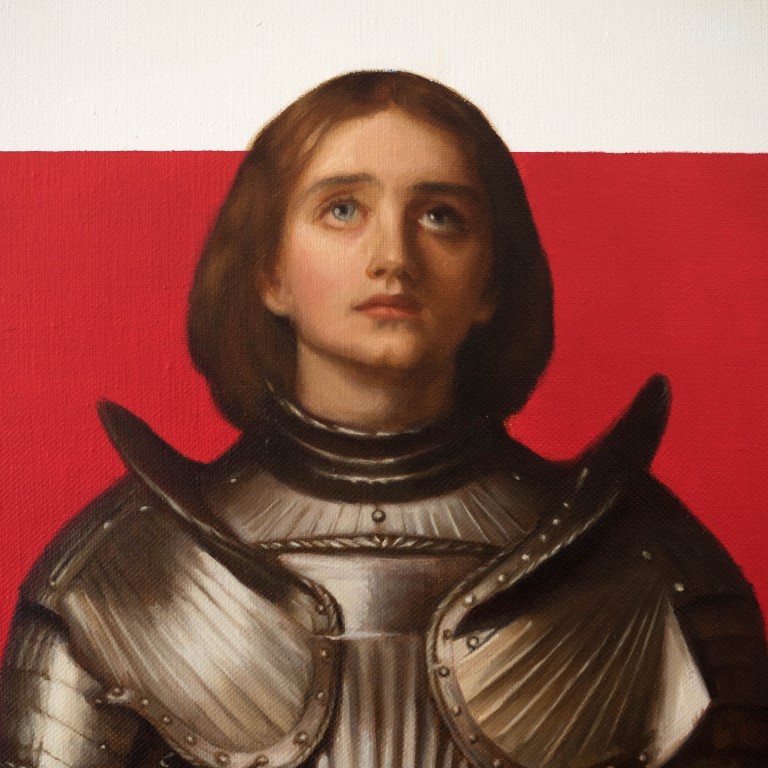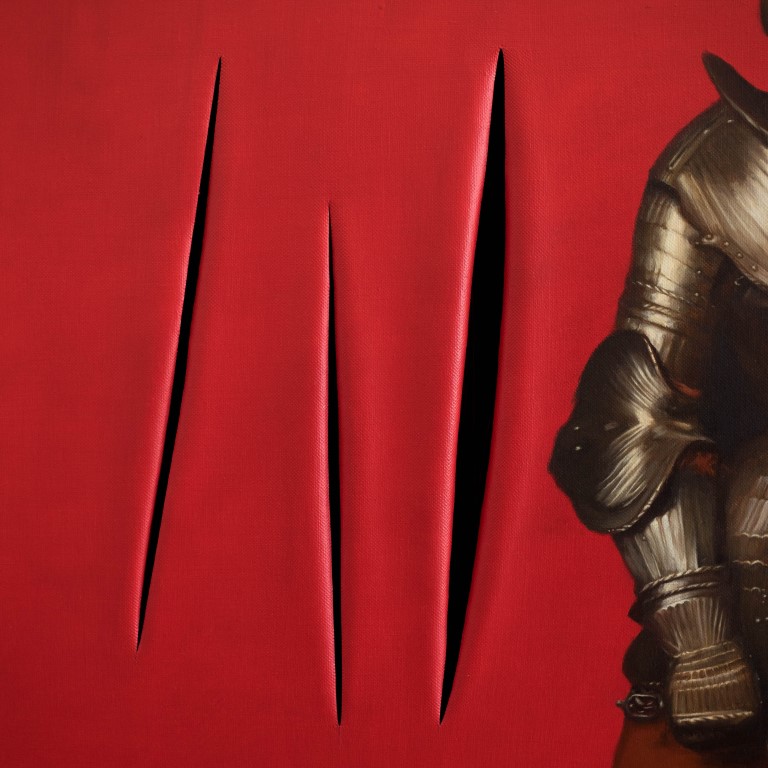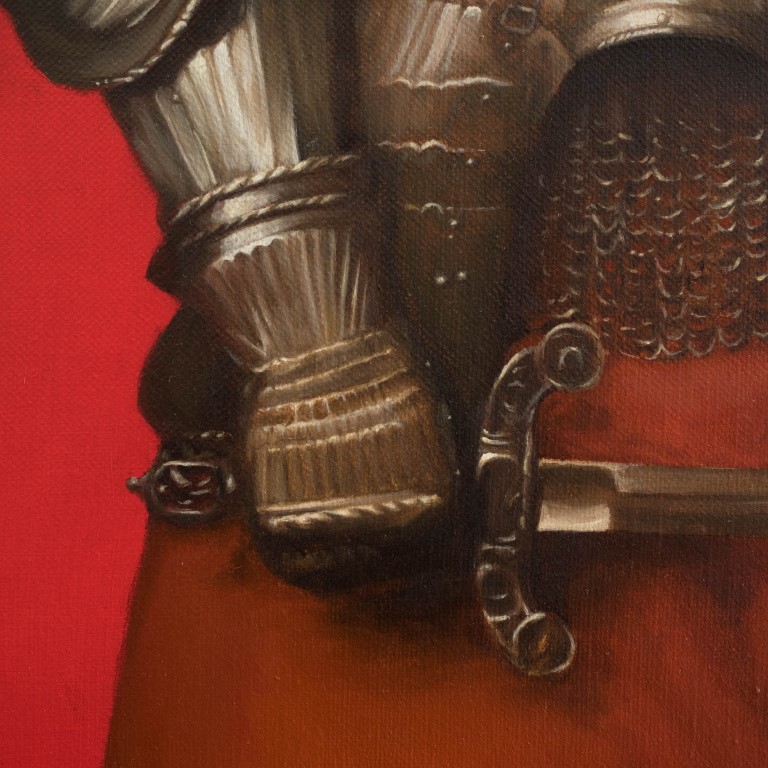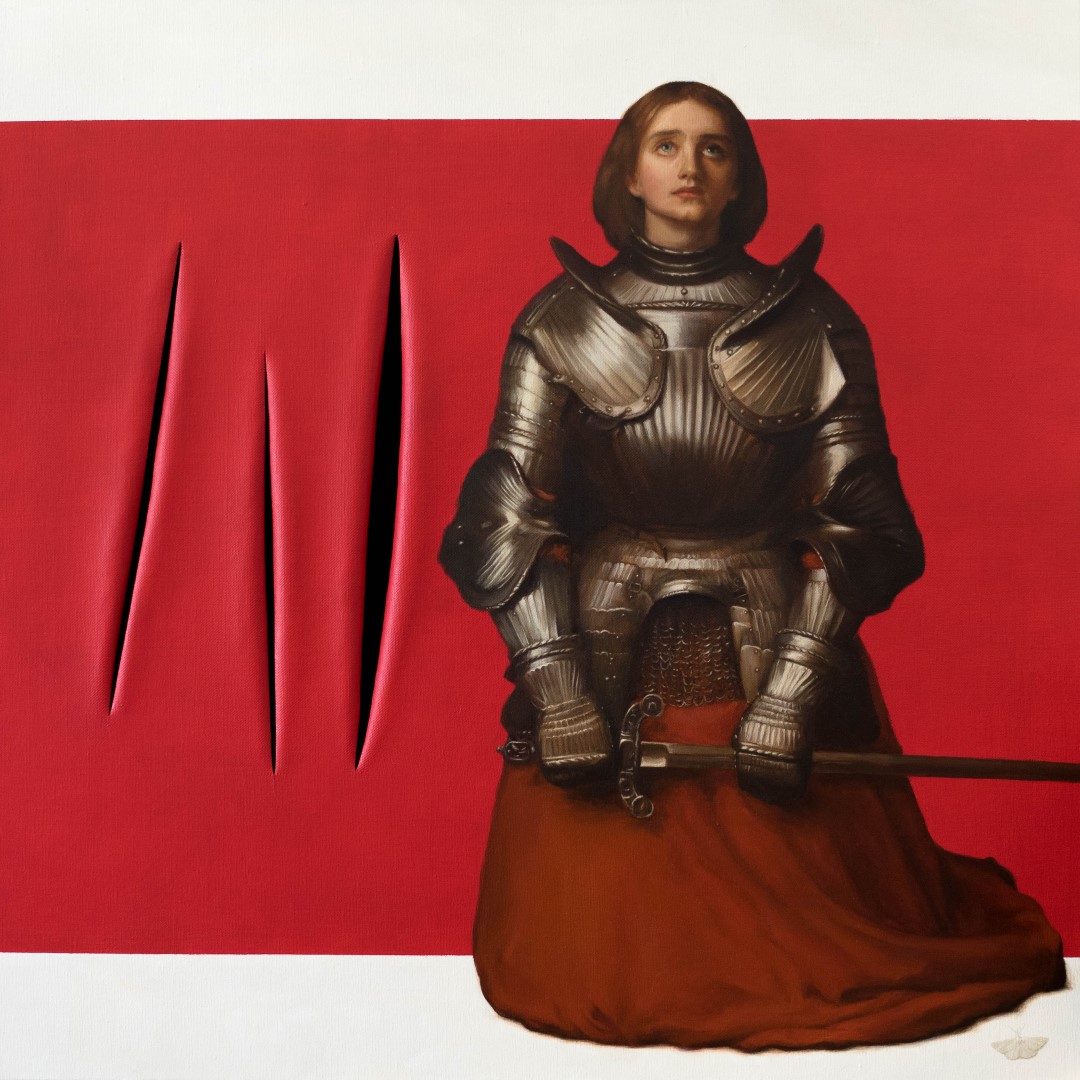
Joanna Fontana depicts the figure of Joan of Arc against the background of a cut canvas inspired by the work of Lucio Fontana. The prototype of the figure comes from the painting of John Everett Millais, a British painter and a member of the Pre-Raphaelite Association who modelled their works after the masters of the early Italian Renaissance.
The figure presented in the context of the cuts in the canvas covered with smooth red paint gives her a new dimension. Lucio Fontana’s paintings themselves caused a lot of controversy and were interpreted in various ways. His “Concetto spaziale” (Spatial Concept) cycle involved interfering with the plane of the image by making rhythmic or single cuts called tagli in Italian (cuttings). In this way, he blurred the lines between the painting and the sculpture, but also between the work of art and the surrounding space. “My discovery was the hole and that’s it. I am happy to go to the grave after such a discovery”, Fontana said about his art piece. These works were given an additional subtitle attesa, which means “expectation”. Although Fontana’s works can be interpreted in many ways, they are often compared to injured skin or female genitals.
In this context, the figure of Joan of Arc seems to be placed in this place by no accident. In the painting, she is depicted in armour, with a sword in her hand, as if she had made the cuts in question, in order to create art in battle and drudgery. On the other hand, the Virgin of Orleans had to dress in men’s clothes and suffer blows in order to fight; and all that to die a martyr’s death. Personally, I think of it as a reference that suggests connotations with the position of women in the art world. For many years, women were not even allowed to pursue an art degree, and there were even cases such as Zofia Stryjeńska’s, who was forced to dress like a man to be able to study.
But there is one more connection that I cannot fail to mention. The signature of “L. Fontana”, as Lucio used to sign, could have also been signed by the outstanding artist of the Mannerist style – Lavinia Fontana. She was one of the first women ever to achieve great success in the field of art. Nowadays, however, when thinking about “Fontana’s work”, most people think of the cut images of the contemporary artist. Perhaps the subtitle of attesa (expectation) in this case gives hope for change.
The title “Joanna Fontana” refers to the way modern culture creates the figure of a woman and the modern female role models.