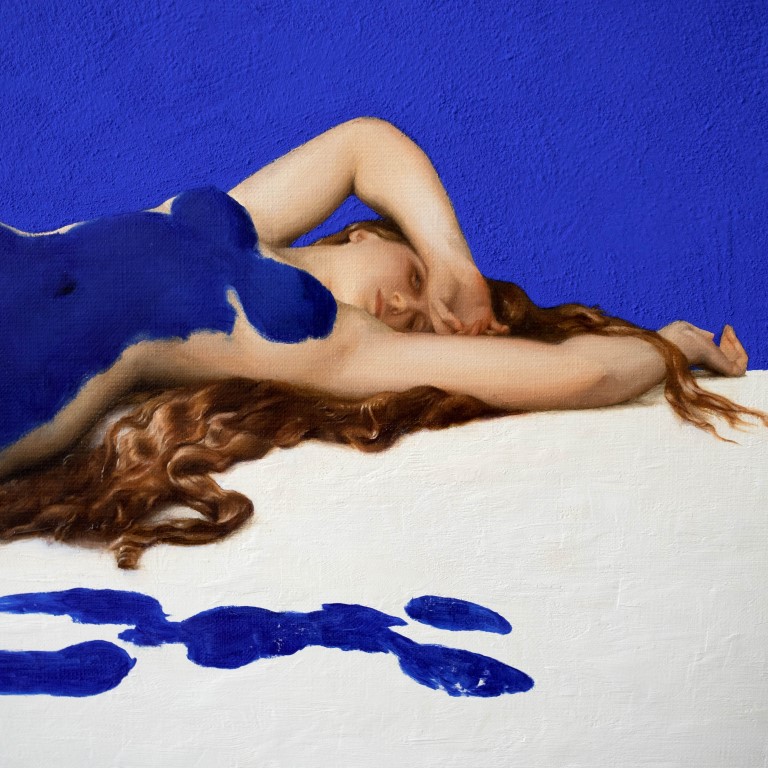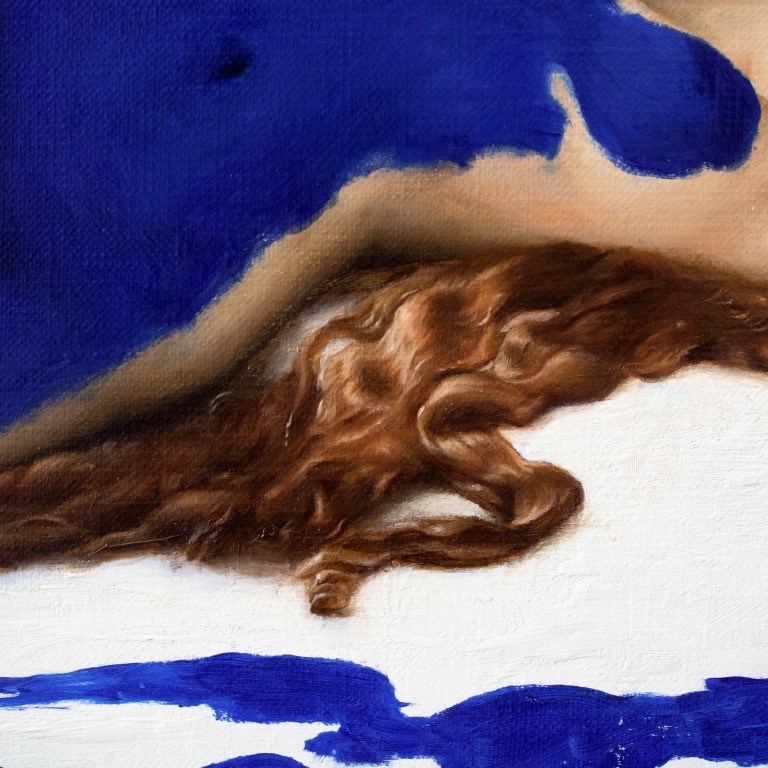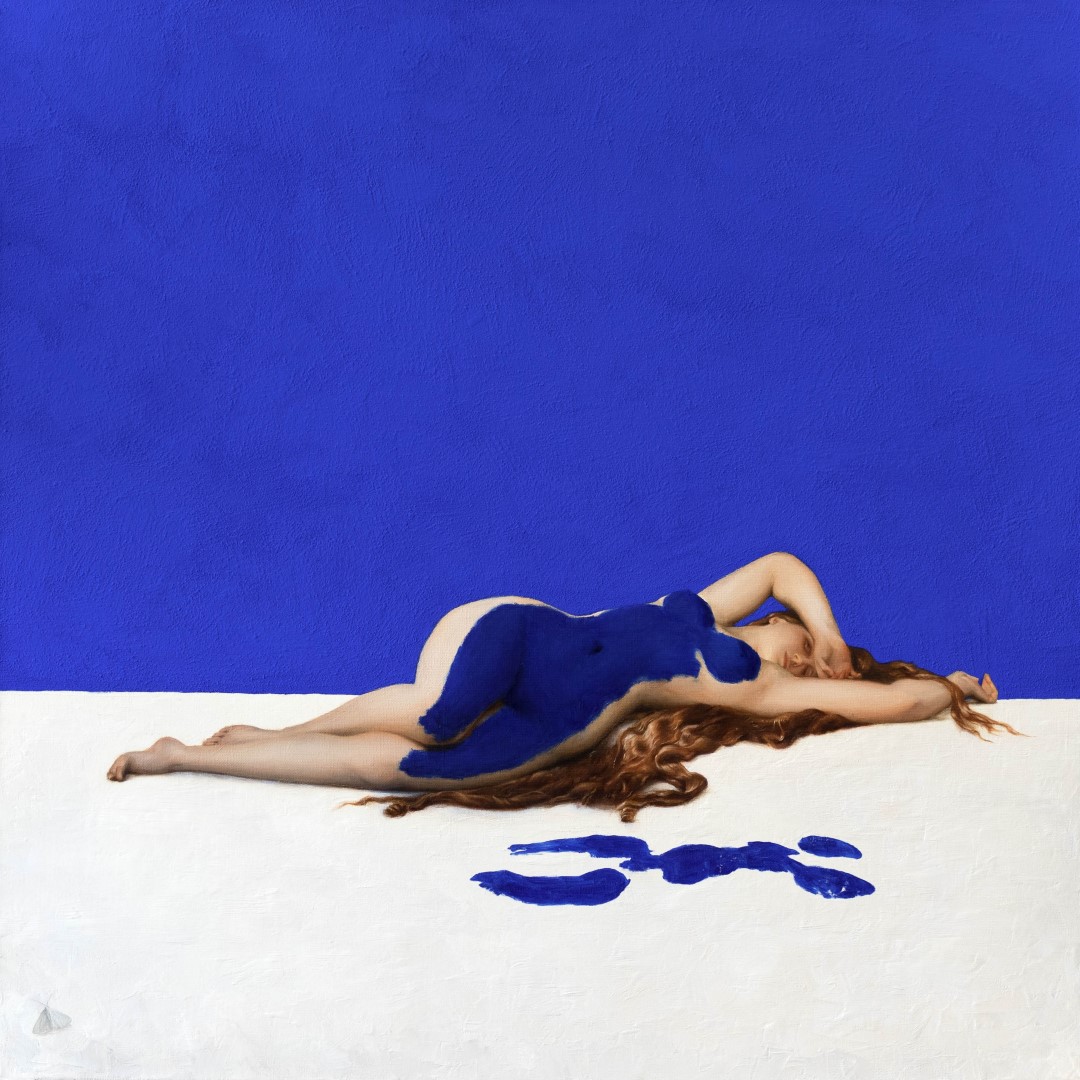
Anthropometry of Venus was inspired by the works of a French artist Yves Klein, who was fascinated by the colour blue. Enchanted by the hue and symbolism of this colour, he used it in his works in various ways. Together with Edouard Adam, he created and patented International Klein Blue, a new type of blue paint which, thanks to the use of a special binder, took on the appearance of a dry pigment without losing colour saturation. The artist experimented with the texture of the works, using various additions to make his blue more diverse. He also used it on plaster casts of famous sculptures such as, among others, Venus and Nike. One of his most famous works was a series of performance art events in which the artist used the bodies of models soaked in blue paint who then left their imprints on paper or canvas to create paintings.
Blue has been one of the most valuable pigments for years. Especially its lapis lazuli variety in its time was extremely expensive, comparable to the value of gold, because it could only be obtained from rocks mined in today’s Afghanistan. However, no other blue pigment, until the invention of synthetic counterparts, was so intense and durable, which is why it was reserved mostly for the colour of the robes of the most important figures, primarily for the Mother of God and angels.
Klein once said, “Blue has no dimensions, it is beyond dimensions, whereas the other colours are not. They are pre-psychological expanses, red, for example, presupposing a site radiating heat… All colours arouse specific associative ideas, psychologically material or tangible, while blue suggests at most the sea and sky, and they, after all, are in actual, visible nature what is most abstract”.
Klein noted that the main problem in the work of Kazimierz Malevich was the shape. For Klein himself it was the colour, as he stated: “Malevich stood before infinity, and I am in it”.
In my art piece, I tried to recreate the paint invented by Yves Klein in my own way. I also used the figure of Venus from the painting of Alexandre Cabanel, a representative of French academicism, who plays a part in the performance art created by Yves Klein.
The art piece shows the path that the art originating from a similar environment has taken over a period of a hundred years or so. All artists are unified in a common purpose: to search for the ideal of beauty and divinity; and therefore, to direct the audience towards the absolute.
On the one hand, the title refers to the famous performance art of Yves Klein, but at the same time it refers to anthropometry as a research method which compares the dimensions and proportions of body parts (in the case body parts of Venus, the goddess of beauty) and thus becomes a method of searching for the physical human ideal. However, just as art changes over time, the canons of beauty also change, so the ideal turns out to be not so much unattainable as imprecise.